Negotiation simulation

Tamaani The Mine of Consent

A practical simulation where participants experience how consent is shaped, pressured, weakened, or protected in extractive industry negotiations. Not a lecture. A practical exercise in power asymmetry.

PROJECT SITE
FIELD FOOTAGE
Was consent freely given — or was it extracted?

The central question Tamaani asks every participant to answer — for themselves.

Two sides. One negotiation.
No easy answers.

Participants play as either the Company or the Community. Each side has goals, tools, and constraints shaped by real negotiation dynamics.

Digital development →
01

Two distinct prototypes

Tamaani has two distinct prototypes: a fictional mining negotiation, The Headwaters Project (Meridian Minerals, English pilot v0.2), and a separate online Sarayaku case-based prototype. They are not interchangeable. The fictional version is being revised and tested before online release.

02

One gauge: project pressure

Instead of three abstract metrics, the game now tracks a single number — Project Pressure, from 0 to 50. It rises with each company move, and it also drifts upward on its own every round, faster for every consent violation left unresolved.

03

Limited community resources

Law, Information, Allies, and Community support — four resources that do not replenish. Every response the Community takes costs one of them, forcing real trade-offs instead of a free choice of "the right answer."

04

An ending decided by facts, not luck

The session ends when pressure hits 10 (the project is rolled back), hits 50 (a point of no return), or is stopped for debrief. Every playthrough closes with what actually happened in this case — including the 2012 Inter-American Court ruling.
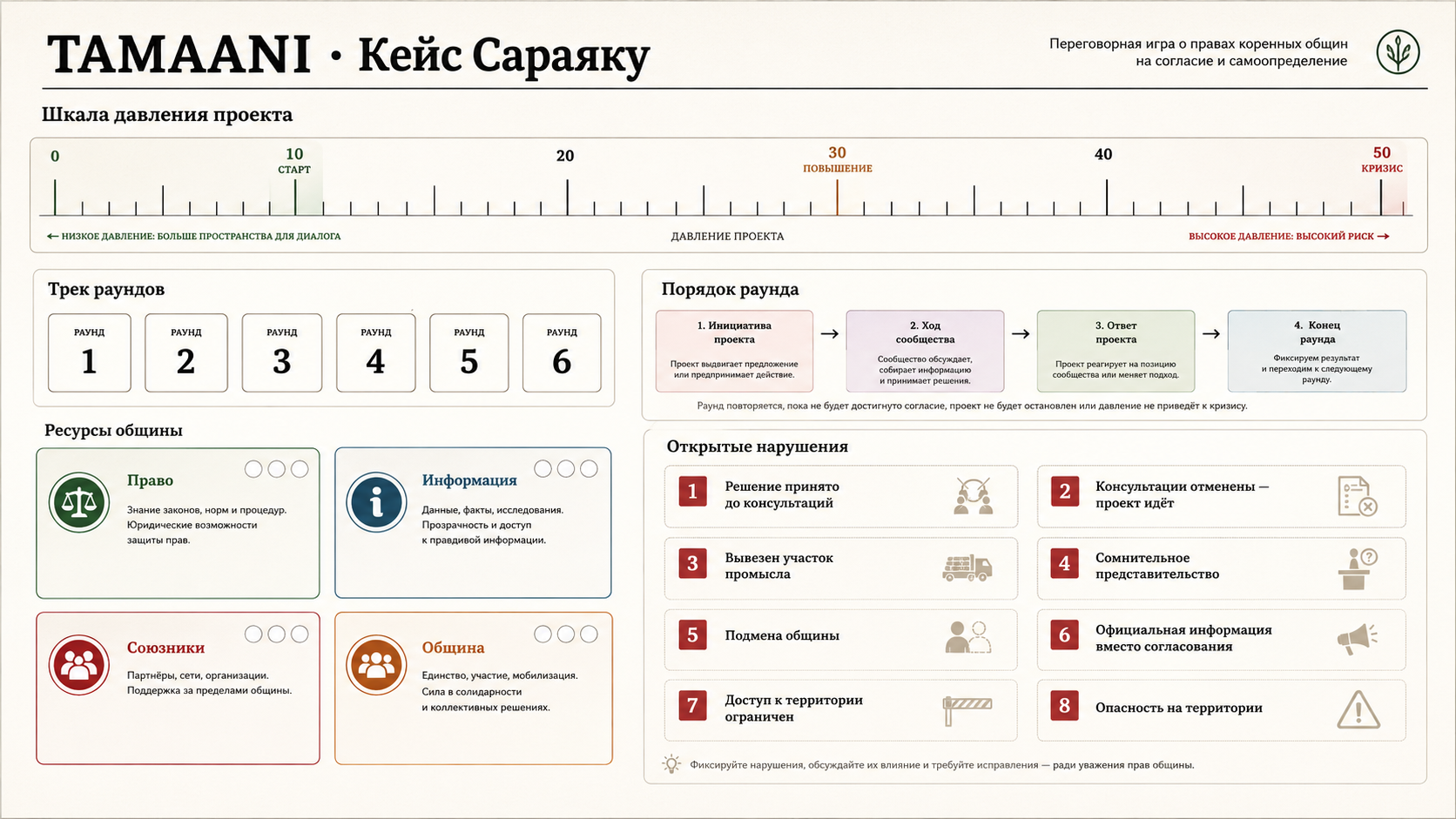
Схема механики Tamaani: шкала давления проекта, порядок раунда, ресурсы общины и открытые нарушения
Open full size →

FPIC as a lived process, not a legal principle.

Participants do not learn about FPIC from a presentation. They experience it — under pressure, with incomplete information, and real consequences.

How promises become pressure

Benefits, jobs, and development offers that seem fair at first — and what they do to community cohesion over time.

How benefits divide communities

Individual offers versus collective rights. The mechanics of manufactured consent within communities.

How information gaps change consent

What changes when one side lacks environmental data, legal capacity, or technical expertise to evaluate risks.

Why independent advice matters

The structural difference between a community advised by the company's lawyers and one with independent legal support.

How grievance mechanisms work — and fail

What makes a grievance mechanism legitimate, accessible, and actually responsive to community concerns.

Why some harms are irreversible

Participants confront moments where even perfect consent later cannot undo harm already done — and learn to see those moments in advance.

Who it is for

Built for those who already know
something is broken.

Tamaani is not an introduction to mining for general audiences. It is a field tool for people who work with, in, or around extractive negotiations — and want to go deeper.

Indigenous communities & organizations

For community leaders, negotiators, and advocates who want to build capacity around FPIC, consent processes, and negotiation rights.

Civil society & NGOs

For organizations supporting communities in extractive negotiations, or advocating for stronger FPIC standards in national and international policy.

Educators & universities

For courses in law, human rights, Indigenous studies, development, environmental policy, and corporate accountability.

Foundations & funders

For grantmakers who fund community rights, responsible extraction, or Indigenous advocacy — and want to better understand what they're supporting.

Journalists & researchers

For those covering mining, critical minerals, energy transition, or Indigenous rights who want to understand negotiation dynamics from the inside.

Responsible sourcing teams

For companies genuinely willing to understand power asymmetry and improve community engagement practices — not to check compliance boxes.

Formats

From a 90-minute demo
to a full regional adaptation.

Tamaani can be adapted to your context, your audience, and your goals. All sessions include facilitated debrief.

Format
Description
Best for
Introductory demo 90 minutes

A compressed session that gives participants a direct experience of the game's core dynamics. Includes debrief and Q&A. Ideal for first contact before a longer commitment.

Organizations considering Tamaani for training. Conferences and events. Exploratory partnerships.

Workshop Half-day or full day

Full session with multiple rounds, external event cards, role negotiation, and a structured facilitated debrief. Participants leave with a shared vocabulary for the dynamics they experienced.

Civil society coalitions. University courses. Multi-stakeholder forums. Foundation convenings.

Training Multi-session

Adapted for a specific group with sustained learning goals: community leaders building negotiation capacity, CSO staff, university students, or mixed practitioner groups over several sessions.

Community capacity building. NGO staff training. Graduate courses.

Regional adaptation Custom

Cards, scenarios, event decks, and case references adapted to a specific region, legal framework, mineral type, or community context. Includes co-development process.

Long-term partnerships. Region-specific training programs. Context-embedded learning.

Pilot partnerships

Test the decisions behind consent.

We are seeking organizations to co-design and support facilitated FPIC learning pilots. The simulation explores pressure, information gaps and decision-making power; it is not a certification of consent or a validated human rights impact assessment.

Host a pilot

Bring a facilitated session to a learning group, conference or organization, followed by a structured debrief and feedback.

Indigenous organizations, universities, civil society and practitioners.

Co-develop a scenario

Explore a context-specific adaptation with appropriate community involvement, safeguards and a clearly agreed scope.

Training partners and research collaborators.

Support development

Discuss funding for pilot delivery, facilitator preparation, accessibility, translation and evaluation.

Foundations, training programmes and institutional partners.

Tamaani is a learning simulation, not a substitute for Indigenous Peoples' own decision-making processes or for free, prior and informed consent.

Discuss a pilot or partnership →

Developed from
research and case-based discussions.

Tamaani was created by Aivana, an Indigenous rights researcher and advocate from Chukotka, currently based in Armenia.

Her work focuses on Indigenous Peoples' rights, FPIC, extractive industries, corporate accountability, grievance mechanisms, and the risks of superficial consultation processes.

The game was developed as a practical tool to help people see what is often hidden in formal negotiations: asymmetry, pressure, incomplete information, and the difference between participation and real consent.

It is not a neutral tool. It is a tool built with a clear perspective: that free, prior, and informed consent requires structural conditions — and that those conditions are routinely undermined in real negotiations.

Focus areas

COP31 · In the news

Right to say no.

Indigenous Russia interviewed Tamaani creator Aivana Enmynkau about the game's presentation at COP31 in Antalya, the unequal conditions of mining negotiations and why consultation alone does not guarantee consent.

Read the COP31 story →Original interview (RU) →
The team
Николай
 
Елена
 
Александр
 
Айвана
 
Request a session

Bring Tamaani to your
organization or course.

If you work with communities, teach about rights and extraction, or fund organizations in this space — we'd like to talk about how Tamaani can be useful for your context.

Request a demo session →
Digital development

From facilitated sessions to interactive learning.

The Sarayaku case-based prototype can be explored online today. A separate digital adaptation of the fictional Meridian Minerals negotiation is in development, with mobile-friendly participation planned. The digital product is not yet a finished mobile app.

Explore the online prototype →

Request a demo session

Tell us about your context and we will follow up within a few days to discuss how Tamaani can be adapted to your needs.