A practical simulation where participants experience how consent is shaped, pressured, weakened, or protected in extractive industry negotiations. Not a lecture. A practical exercise in power asymmetry.
Was consent freely given — or was it extracted?
The central question Tamaani asks every participant to answer — for themselves.
Participants play as either the Company or the Community. Each side has goals, tools, and constraints shaped by real negotiation dynamics.
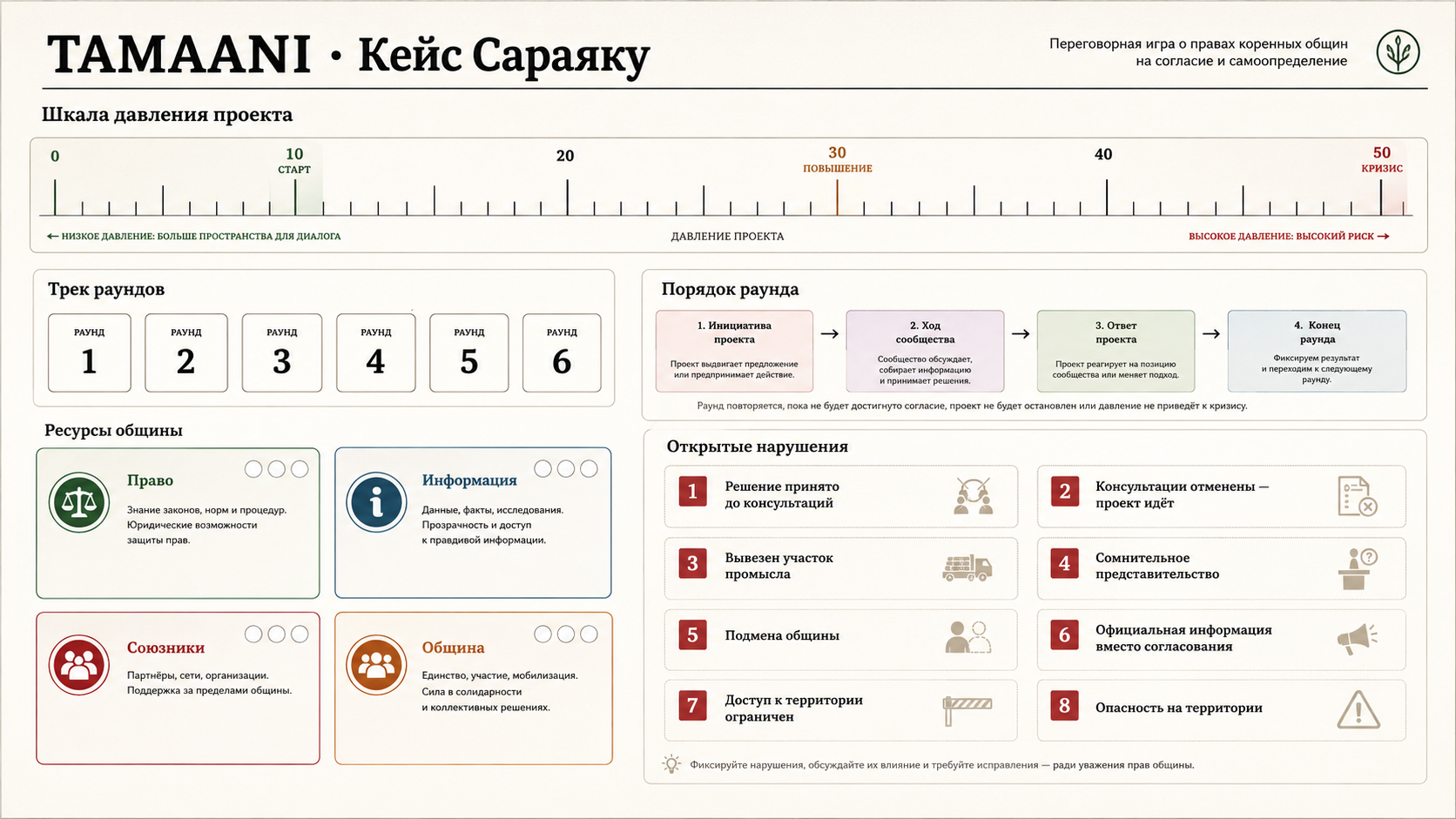
Play the online demo →The current build is based on the Sarayaku Kichwa people's case against Ecuador: an oil concession granted over their territory without consultation. The game starts where the real story starts — consent already bypassed.
Instead of three abstract metrics, the game now tracks a single number — Project Pressure, from 0 to 50. It rises with each company move, and it also drifts upward on its own every round, faster for every consent violation left unresolved.
Law, Information, Allies, and Community support — four resources that do not replenish. Every response the Community takes costs one of them, forcing real trade-offs instead of a free choice of "the right answer."
The session ends when pressure hits 10 (the project is rolled back), hits 50 (a point of no return), or is stopped for debrief. Every playthrough closes with what actually happened in this case — including the 2012 Inter-American Court ruling.
Participants do not learn about FPIC from a presentation. They experience it — under pressure, with incomplete information, and real consequences.
Benefits, jobs, and development offers that seem fair at first — and what they do to community cohesion over time.
Individual offers versus collective rights. The mechanics of manufactured consent within communities.
What changes when one side lacks environmental data, legal capacity, or technical expertise to evaluate risks.
The structural difference between a community advised by the company's lawyers and one with independent legal support.
What makes a grievance mechanism legitimate, accessible, and actually responsive to community concerns.
Participants confront moments where even perfect consent later cannot undo harm already done — and learn to see those moments in advance.
Tamaani is not an introduction to mining for general audiences. It is a field tool for people who work with, in, or around extractive negotiations — and want to go deeper.
For community leaders, negotiators, and advocates who want to build capacity around FPIC, consent processes, and negotiation rights.
For organizations supporting communities in extractive negotiations, or advocating for stronger FPIC standards in national and international policy.
For courses in law, human rights, Indigenous studies, development, environmental policy, and corporate accountability.
For grantmakers who fund community rights, responsible extraction, or Indigenous advocacy — and want to better understand what they're supporting.
For those covering mining, critical minerals, energy transition, or Indigenous rights who want to understand negotiation dynamics from the inside.
For companies genuinely willing to understand power asymmetry and improve community engagement practices — not to check compliance boxes.
Tamaani can be adapted to your context, your audience, and your goals. All sessions include facilitated debrief.
A compressed session that gives participants a direct experience of the game's core dynamics. Includes debrief and Q&A. Ideal for first contact before a longer commitment.
Organizations considering Tamaani for training. Conferences and events. Exploratory partnerships.
Full session with multiple rounds, external event cards, role negotiation, and a structured facilitated debrief. Participants leave with a shared vocabulary for the dynamics they experienced.
Civil society coalitions. University courses. Multi-stakeholder forums. Foundation convenings.
Adapted for a specific group with sustained learning goals: community leaders building negotiation capacity, CSO staff, university students, or mixed practitioner groups over several sessions.
Community capacity building. NGO staff training. Graduate courses.
Cards, scenarios, event decks, and case references adapted to a specific region, legal framework, mineral type, or community context. Includes co-development process.
Long-term partnerships. Region-specific training programs. Context-embedded learning.
Tamaani was created by Aivana, an Indigenous rights researcher and advocate from Chukotka, currently based in Armenia.
Her work focuses on Indigenous Peoples' rights, FPIC, extractive industries, corporate accountability, grievance mechanisms, and the risks of superficial consultation processes.
The game was developed as a practical tool to help people see what is often hidden in formal negotiations: asymmetry, pressure, incomplete information, and the difference between participation and real consent.
It is not a neutral tool. It is a tool built with a clear perspective: that free, prior, and informed consent requires structural conditions — and that those conditions are routinely undermined in real negotiations.
Game updates, session reports, and FPIC news — collected as they happen.
The prototype now runs on a single Project Pressure gauge, four limited community resources, and a real case timeline — with a live demo you can play online.
July 2026A first demo session with partner organizations tested the debrief format and gathered feedback that shaped the current build.
June 2026A look at the Inter-American Court's 2012 decision and what it continues to mean for free, prior, and informed consent today.
June 2026If you work with communities, teach about rights and extraction, or fund organizations in this space — we'd like to talk about how Tamaani can be useful for your context.